How Climate, Rainfall, and Lake Conditions Shape Wildlife, Birding, and Travel
Lake Nakuru National Park sits in Kenya’s central Rift Valley at roughly 1,750–1,800 m (≈5,700–5,900 ft) above sea level. This elevation moderates temperatures year-round, giving the park warm days, cool nights, and a climate driven primarily by two rainy seasons and two drier intervals.
Because Nakuru is centered on a shallow soda lake, weather does more than affect comfort—it directly shapes:
- Lake levels and chemistry
- Algal and invertebrate productivity
- Flamingo and waterbird presence
- Vegetation growth and grazing patterns
- Road conditions and visibility
Understanding the monthly climate cycle helps you plan both the best experience and responsible expectations.
🌍 Climate Overview (The Big Picture)
- Temperature: Generally mild to warm year-round due to elevation.
- Daytime highs usually 22–28°C (72–82°F)
- Nighttime lows often 8–14°C (46–57°F)
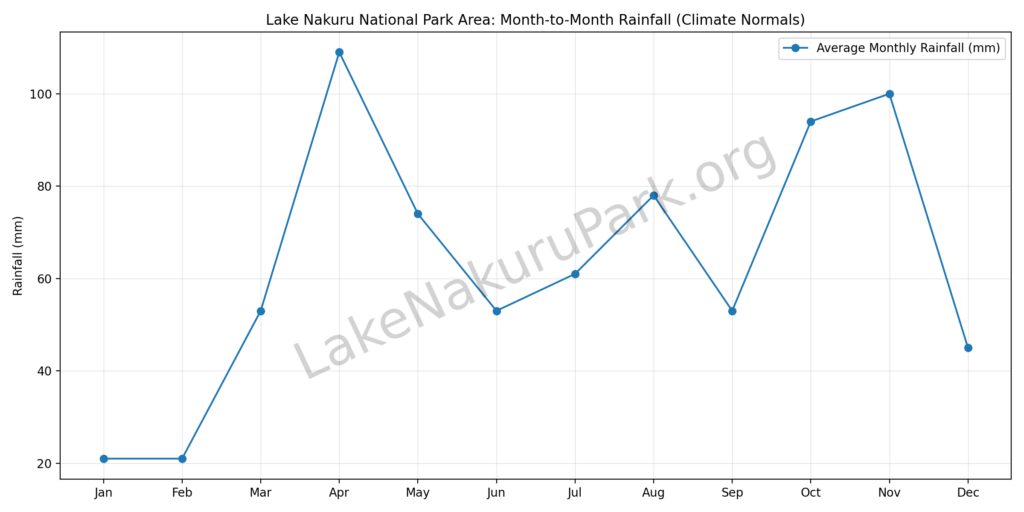
- Rainfall pattern:
- Long rains: March–May
- Short rains: October–December
- Drier periods: January–February and June–September
- Winds:
- Often breezier in the dry season and during weather transitions
- Afternoon lake breezes are common and can cool temperatures noticeably
- Lake response:
- Heavy rains can raise lake levels, dilute salinity, and flood shorelines
- Dry periods can concentrate salts, expose mudflats, and change food availability for birds
Lake Nakuru NP Temperature by Month:
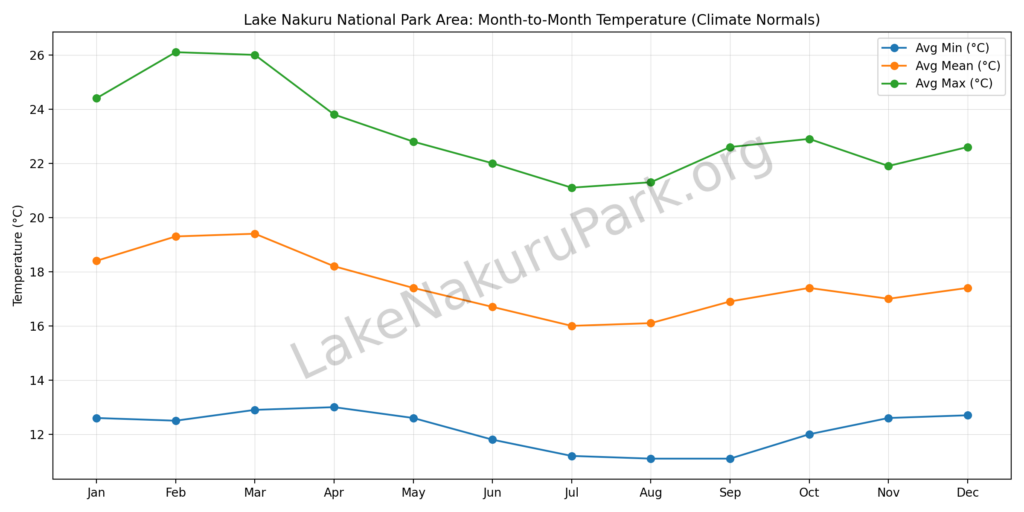
Lake Nakuru National Park has a mild, equable Rift Valley climate moderated by its elevation, with warm days and cool nights year-round rather than extreme heat. Average daytime temperatures generally range from the low 20s°C in the coolest months (June–August) to the mid–upper 20s°C in the warmest months (February–March), while nights commonly fall to around 10–13°C.
Seasonally, the coolest period is the mid-year dry season (June–August), when overcast mornings and breezes keep daytime highs closer to ~21–22°C, whereas the warmest period is late dry season to early long rains (February–March), when clearer skies push highs toward ~26°C. The long rains (March–May) and short rains (October–December) bring slightly cooler, more humid conditions with daytime temperatures typically in the low–mid 20s°C.
Overall, temperature variation across months is modest; what visitors notice more is the day–night contrast and how cloud cover and rainfall, rather than heat, shape comfort and wildlife activity at Lake Nakuru.
🗓️ Month-by-Month Weather Guide for LNNP
🌤️ January — Warm & Relatively Dry
- Weather: Warm days, cool nights; generally dry with occasional showers
- Landscape: Green from recent short rains but starting to dry
- Wildlife & birds: Good general wildlife viewing; waterbirds spread across wetlands
- Lake conditions: Often stable, but still influenced by late-year rains
- Travel notes: Good roads; dust may begin to increase
- Pack: Light layers for day, warm layer for evenings, sun protection
🌤️ February — Hottest & Drying
- Weather: One of the warmest and driest months
- Landscape: Vegetation starts to thin; visibility improves
- Wildlife & birds: Animals concentrate near water; raptors are very active
- Lake conditions: Gradual concentration of salts possible; shoreline feeding zones may improve for some birds
- Travel notes: Excellent driving conditions; dust can be noticeable
- Pack: Sun protection, breathable clothing, light jacket for mornings
🌦️ March — Start of the Long Rains
- Weather: Increasing humidity; rains become more frequent
- Landscape: Rapid greening; grasses and shrubs respond quickly
- Wildlife & birds: Breeding activity begins for many species; insect life increases
- Lake conditions: Water levels often start to rise; chemistry begins to shift
- Travel notes: Some roads may become muddy after heavy showers
- Pack: Light rain jacket, waterproof footwear, quick-dry clothes
🌧️ April — Peak of the Long Rains
- Weather: Wettest month in most years; cooler, cloudier days
- Landscape: Lush and very green
- Wildlife & birds: Excellent for bird diversity; mammals more dispersed due to abundant water
- Lake conditions: Rising or high water levels; shoreline shapes may change
- Travel notes: Muddy sections possible; fewer visitors; dramatic scenery
- Pack: Rain gear, waterproof bags, warm layer for cool evenings
🌧️ May — Rains Tapering Off
- Weather: Still wet, but rainfall gradually decreases
- Landscape: Peak greenery; wildflowers and fresh growth common
- Wildlife & birds: Great for birds and scenery; mammals still spread out
- Lake conditions: Often high or stabilizing after rains
- Travel notes: Roads improve toward the end of the month
- Pack: Rain protection still useful; layers for variable conditions
🌤️ June — Cool & Drying
- Weather: Cooler, drier, with clear mornings and crisp nights
- Landscape: Green but beginning to dry
- Wildlife & birds: Visibility improves; good balance of greenery and game viewing
- Lake conditions: Water levels begin to stabilize or slowly recede
- Travel notes: Excellent for photography and comfortable travel
- Pack: Warm layer for mornings/evenings, light daytime clothing
🌬️ July — Cool, Dry & Breezy
- Weather: One of the coolest months; often windy
- Landscape: Drying grasslands; clear skies common
- Wildlife & birds: Strong raptor activity; mammals easier to spot
- Lake conditions: More exposed shorelines in many years; good for waders
- Travel notes: Very good road conditions; dust possible
- Pack: Windbreaker or fleece, sun protection
🌬️ August — Dry Season Peak
- Weather: Dry, cool mornings, mild days
- Landscape: Brownish grasslands, high visibility
- Wildlife & birds: Excellent general wildlife viewing; strong birding for raptors and open-country species
- Lake conditions: Often productive shallow margins if levels are moderate
- Travel notes: Peak safari comfort; popular travel period
- Pack: Layers, sunscreen, lip balm (dry air)
🌤️ September — Warming, Still Dry
- Weather: Gradually warming; still mostly dry
- Landscape: Dry season look continues
- Wildlife & birds: Concentrations around water; good predator sightings
- Lake conditions: Similar to August; chemistry and food availability drive bird presence
- Travel notes: Excellent travel conditions
- Pack: Light clothing plus a warm layer for early starts
🌦️ October — Start of the Short Rains
- Weather: Increasing cloud and scattered showers
- Landscape: First flush of green returns
- Wildlife & birds: Migratory birds begin to appear; breeding activity increases
- Lake conditions: Water levels may start rising again
- Travel notes: Roads generally still good, but showers can cause brief mud
- Pack: Light rain jacket, quick-dry clothes
🌧️ November — Short Rains Peak
- Weather: Regular showers, warm days, cooler nights
- Landscape: Greener again; fresh growth
- Wildlife & birds: Excellent bird diversity; insects abundant; mammals more dispersed
- Lake conditions: Rising or fluctuating levels; changing shoreline feeding zones
- Travel notes: Fewer crowds; lush scenery; some muddy patches
- Pack: Rain gear, waterproof bags, light warm layer
🌦️ December — Rains Ease, Festive Season
- Weather: Showers taper off; mix of sun and clouds
- Landscape: Green and attractive
- Wildlife & birds: Very good birding; young animals and breeding activity common
- Lake conditions: Often still influenced by short rains
- Travel notes: Popular holiday period; generally good driving between showers
- Pack: Light rain jacket, sun protection, layers
🌊 How Weather Shapes the Lake and Flamingos
- Heavy rains → Higher lake levels, diluted salinity, possible changes in algae and invertebrates
- Dry periods → More concentrated salts, exposed mudflats, sometimes better feeding zones
- Result: Flamingo and waterbird numbers can increase, decrease, or shift between lakes depending on these conditions
- This is normal ecosystem behavior, not a fixed “season” pattern
🐦 Weather and Birding: What to Expect
- Wet seasons: Highest species diversity, breeding activity, and migrant presence
- Dry seasons: Better visibility, easier access, strong raptor and open-country birding
- Flamingos: Presence depends more on lake chemistry and depth than on the calendar alone
🚗 Road & Travel Conditions by Season
- Best driving: January–February, June–September
- Challenging (but scenic): April and November during heavier rains
- Park accessibility: Generally year-round, with short muddy sections after heavy showers
🎒 What to Pack (All Year)
- Light, breathable daytime clothes
- Warm layer for mornings/evenings
- Rain jacket (especially March–May and Oct–Dec)
- Sun protection (hat, sunscreen, sunglasses)
- Comfortable, closed shoes
- Binoculars and camera protection from dust/rain
🏁 Choosing the Best Month: The Honest Answer
There is no bad month to visit Lake Nakuru—only different experiences:
- Want dry, easy travel and classic safari conditions? Choose July–September or January–February.
- Want lush landscapes and peak bird diversity? Choose April–May or November–December.
- Want balance? Choose June or October.
What matters most is understanding that weather, water, and wildlife are linked. Lake Nakuru is a living system, and each month shows a different, equally valuable face of that system.
Changing Dynamics of Lake Nakuru Weather & Climate:
- 🌦️ Rainfall in the Rift Valley is naturally uneven and increasingly unpredictable, shaped by escarpments, elevation, and rain-shadow effects, with long rains (Mar–May), short rains (Oct–Dec), and drier periods (Jan–Feb, Jun–Sep).
- 📈 Recent decades show clear shifts toward more erratic timing, more intense rainfall events, and longer dry intervals, driving greater variability in lake levels and water chemistry.
- 🌊 Lake Nakuru is a closed-basin, shallow alkaline lake, so even modest rainfall changes can cause rapid expansion, shoreline flooding, and chemical dilution, while dry periods expose mudflats, increase salinity, and concentrate algae.
- 🔄 These water-level oscillations are natural but now more extreme and frequent, reflecting climate-amplified variability rather than a new ecological process.
- 🌡️ Climate change is amplifying existing extremes, leading to more frequent high-water phases, longer diluted-chemistry periods, shoreline vegetation die-off, and altered algal bloom cycles.
- 🦩 Flamingos respond primarily to water chemistry, not water depth—high water does not equal good flamingo conditions if alkalinity and algal food decline.
- 🐦 When chemistry shifts, flamingos move rapidly to other Rift Valley soda lakes, a sign of adaptive resilience rather than population collapse.
- 🦆 Other waterbirds often benefit from higher water levels (ducks, geese, pelicans, herons, cormorants), while lower water favors waders, shorebirds, and sometimes flamingo feeding efficiency when chemistry aligns.
- 🌿 Overall bird diversity usually remains high, even when iconic species like flamingos fluctuate.
- 🦓 Mammal and terrestrial wildlife distributions shift with lake levels: high water submerges grasslands and pushes grazers upslope; dry periods expand grazing areas and concentrate animals near remaining water.
- 🌳 Vegetation responds rapidly to flooding and drying, with shoreline tree loss, new grassland establishment, and long-term woodland composition changes reshaping habitats.
- 🧪 These habitat transformations alter nesting sites, grazing patterns, and predator movements, making Lake Nakuru a natural laboratory for climate-driven ecosystem change.
- 🛡️ Because the park is fenced and actively managed, these pressures are monitored and mitigated through habitat and population management where necessary.
- 🌍 Variability is not a conservation failure: in this system, resilience depends on mobility, diversity, and regional connectivity, not ecological stability.
- 🧭 Lake Nakuru functions best as one node in a wider Rift Valley wetland network, where conservation success means maintaining options and linkages rather than fixing conditions in place.
- 🏁 Expert takeaway: Lake Nakuru’s changing water, climate, and habitats highlight its role as a resilient, adaptive ecosystem and a powerful indicator of how wildlife survives in a changing climate.