
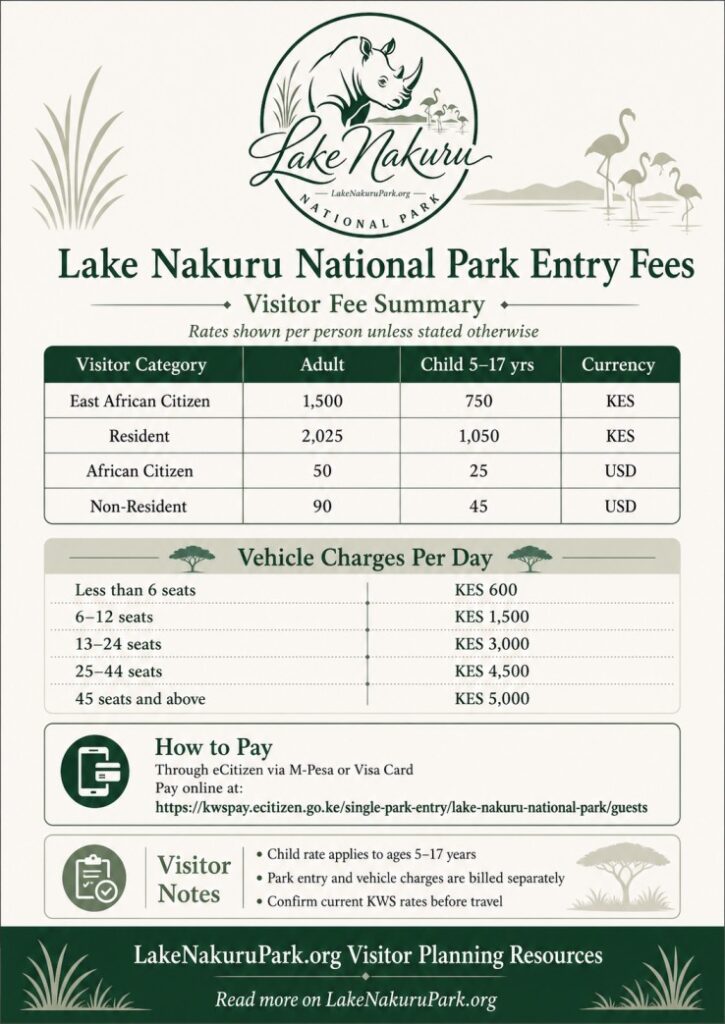
Lake Nakuru National Park entry fees are Ksh 1,500 for East African citizen adults, Ksh 2,025 for Kenya resident adults, USD 50 for African citizen adults, and USD 90 for non-resident adults. Children and eligible students pay reduced rates: Ksh 750, Ksh 1,050, USD 25, or USD 45, depending on visitor category. Lake Nakuru is classified by KWS as a Premium Park, together with Amboseli National Park.
| Visitor Category | Adult | Child / Student |
|---|---|---|
| East African Citizen | Ksh 1,500 | Ksh 750 |
| Kenya Resident | Ksh 2,025 | Ksh 1,050 |
| African Citizen | USD 50 | USD 25 |
| Non-Resident | USD 90 | USD 45 |
These are personal conservation entry fees. They are charged per visitor, not per vehicle or per group. Adults, children, students, residents, citizens, African citizens, and non-residents are priced differently, so visitors should not rely on one generic “Lake Nakuru fee.”
At Lake Nakuru National Park, one of Kenya’s most visited and biologically rich protected areas, these new rates apply to all categories of visitors: East African citizens, Kenyan residents, African citizens from other countries, and non-residents.
As of October 1, 2025, Kenya Wildlife Service introduced a revised national park fee structure affecting Lake Nakuru National Park and other KWS-managed protected areas beginning in the tourism season of late 2025 and proceeding from 2026, 2027 and beyond.
This guide summarizes the current official 2026 and 2027 entry fees, vehicle and activity charges, payment procedures, and key park regulations so visitors can plan responsibly and support conservation efforts while enjoying a seamless safari experience.
The terms entry fee, entrance fee, gate charge, admission fee, and conservation fee are often used interchangeably by visitors. The most accurate term is conservation fee because it is the KWS charge for entering the protected area. The gate used does not change the personal fee; visitor category does.
Lake Nakuru is priced as a Premium Park because it is one of KWS’s higher-value wildlife parks. It costs more than Scenic Parks such as Hell’s Gate, Mt Longonot, Lake Elementaita Wildlife Sanctuary, Shimba Hills, and Kakamega, and it has the same standard Premium Park fee level as Amboseli.
The Entry Fee Is Not the Full Cost of Visiting Lake Nakuru
The Lake Nakuru National Park entry fee is not the full cost of visiting the park. It is the KWS conservation fee that allows you to enter the protected area.
A simple comparison is an amusement park ticket: the ticket gets you inside, but food, parking, rides, lockers, shows, or special experiences may still cost extra. Lake Nakuru works in a similar way. The entry fee gets you through the gate, but your full visit cost may also include vehicle charges, transport, fuel, a driver-guide, meals, accommodation, camping, picnic use, boating, night game drives, filming, drone use, or other special activities.
| Cost Item | Included in Basic Entry Fee? |
|---|---|
| Personal access to Lake Nakuru National Park | Yes |
| Standard visitor access under KWS rules | Yes |
| Vehicle entry charge | No |
| Safari vehicle hire | No |
| Driver-guide | No |
| Fuel | No |
| Meals | No |
| Accommodation | No |
| Camping | No |
| Picnic charges | No |
| Lake boating | No |
| Night game drive | No |
| Drone, filming, or photography fees | No |
| Conferencing or event charges | No |
KWS lists vehicle charges, camping fees, boating charges, picnic charges, tourism experience fees, event-site fees, filming fees, photography fees, and drone-related charges separately from conservation fees. That is why the entry fee should only be the first line item in your Lake Nakuru safari budget, not the total cost of the visit. The actual total cost is much higher than the entry ticket cost.
A correct Lake Nakuru budget starts with three questions: who is entering (residency/nationality), what vehicle is entering(vehicle seating capacity), and whether any special activities are being added. The entry ticket answers only the first question.
For Lake Nakuru, the add-on costs can include:
- Vehicle entry charges, based on vehicle seating capacity.
- Public camping, charged separately from entry fees.
- Special camping, charged separately and potentially requiring reservation.
- Animal tracking, charged per person.
- Lake boating, charged per person per hour.
- Night game drives, charged per person per trip where available and approved.
- Security guided tours, charged per ranger, with a minimum ranger requirement.
- Helicopter tourism, charged separately from normal entry.
- Participation in wildlife conservation and management experiences, charged as a specialist conservation activity.
- Drone use, charged separately and subject to KCAA and KWS approval.
- Filming and professional photography, charged separately from tourist entry.
- Wedding, graduation, or formal photo sessions, treated as special photography use.
- Conferencing, charged separately by visitor category.
- Conference hall use, listed as a separate facility charge.
- Kitchen hire, listed as a separate facility charge.
- Corporate, private, school, or institutional event-site use, charged separately where applicable.
- Event security, charged separately where required.
- Picnic use, where applicable under KWS station charges.
- Aircraft parking, where aircraft access or aviation-related use applies.
- Vehicle recovery inside the park, charged separately if needed.
Current 2026 Fees Compared with the Old 2024 Rates
The current Lake Nakuru fees are different from the old 2024 rates in both price and visitor-category structure. In the 2024 KWS schedule, Lake Nakuru was listed under Premium Parks with a combined Citizens/Residents adult rate of Ksh 860 and a Non-Resident adult rate of USD 60. In the current 2025/2026 schedule, visitors are separated into East African Citizen, Kenya Resident, African Citizen, and Non-Resident categories.
| Visitor Category | 2024 Rate | 2026 Current Rate | Absolute Fee Increase | Percentage Change |
|---|---|---|---|---|
| East African Citizen Adult | Ksh 860 | Ksh 1,500 | +Ksh 640 | +74.4% |
| East African Citizen Child / Student | Ksh 215 | Ksh 750 | +Ksh 535 | +248.8% |
| Kenya Resident Adult | Ksh 860 | Ksh 2,025 | +Ksh 1,165 | +135.5% |
| Kenya Resident Child / Student | Ksh 215 | Ksh 1,050 | +Ksh 835 | +388.4% |
| Non-Resident Adult | USD 60 | USD 90 | +USD 30 | +50.0% |
| Non-Resident Child / Student | USD 35 | USD 45 | +USD 10 | +28.6% |
| African Citizen Adult | Not separately listed | USD 50 | New category | Not directly comparable |
| African Citizen Child / Student | Not separately listed | USD 25 | New category | Not directly comparable |
To compare the fee increases objectively across both KES and USD categories, we can convert the Kenya shilling amounts into USD using today’s CBK daily exchange rate, then compare both the actual USD-equivalent increase and the percentage increase side by side.
Using the latest CBK daily rate of 1 USD = Ksh 129.19, posted 30 April 2026 – the group with the highest actual USD-equivalent increase is Non-Resident Adult, whose fee rose by USD 30. CBK notes that its published exchange rate helps users gauge the value of the shilling on a given day.
| Visitor Category | 2024 Rate | 2026/Current Rate | Increase in Original Currency | Increase in USD Equivalent | % Change |
|---|---|---|---|---|---|
| Non-Resident Adult | USD 60.00 | USD 90.00 | +USD 30 | +USD 30.00 | +50.0% |
| Kenya Resident Adult | Ksh 860 / USD 6.66 | Ksh 2,025 / USD 15.67 | +Ksh 1,165 | +USD 9.02 | +135.5% |
| Non-Resident Child / Student | USD 35.00 | USD 45.00 | +USD 10 | +USD 10.00 | +28.6% |
| Kenya Resident Child / Student | Ksh 215 / USD 1.66 | Ksh 1,050 / USD 8.13 | +Ksh 835 | +USD 6.46 | +388.4% |
| East African Citizen Adult | Ksh 860 / USD 6.66 | Ksh 1,500 / USD 11.61 | +Ksh 640 | +USD 4.95 | +74.4% |
| East African Citizen Child / Student | Ksh 215 / USD 1.66 | Ksh 750 / USD 5.81 | +Ksh 535 | +USD 4.14 | +248.8% |
| African Citizen Adult | Not separately listed | USD 50 | New category | Not comparable | Not comparable |
| African Citizen Child / Student | Not separately listed | USD 25 | New category | Not comparable | Not comparable |
Ranking by actual USD-equivalent increase:
- Non-Resident Adult: +USD 30.00
- Non-Resident Child / Student: +USD 10.00
- Kenya Resident Adult: +USD 9.02
- Kenya Resident Child / Student: +USD 6.46
- East African Citizen Adult: +USD 4.95
- East African Citizen Child / Student: +USD 4.14
The sharpest structural change is for Kenya residents. They are no longer grouped with citizens at the old Ksh 860 adult rate. The current resident adult rate is Ksh 2,025, which is about 135.5% higher than the old combined citizen/resident rate.
The current child and student rates also matter for families and school groups. The old citizen/resident child-student fee was Ksh 215. The current East African citizen child/student rate is Ksh 750, while the current Kenya resident child/student rate is Ksh 1,050.
Any online article still showing Ksh 860 for citizen/resident adults or USD 60 for non-resident adults is using the old 2024 Lake Nakuru fee table, not the current KWS rates. The updated KWS schedule places Lake Nakuru under Premium Parks, with separate rates for East African citizens, Kenya residents, African citizens, and non-residents.
KWS confirmed that the 2025 conservation-fee regulations followed the last comprehensive review 18 years earlier, and that the revised fees apply to new bookings from 1 October 2025 onward. That long gap suggests the increase was not a routine annual adjustment, so another major Lake Nakuru fee hike is unlikely in the near future. Still, visitors should confirm rates before travel through the official KWS/eCitizen payment process or KWS customer service: 0800 597 000, customerservice@kws.go.ke, or +254 726 610 509.
For 2026 planning, visitors should use the current KWS Premium Park rates unless KWS publishes a newer or revised schedule. Fees can change when KWS updates the conservation fee schedule or the payment system, so visitors booking more than a year ahead should verify the rate again before travel.
Lake Nakuru Entry Fees for East African Citizens
East African citizens pay Ksh 1,500 per adult and Ksh 750 per child or eligible student to enter Lake Nakuru National Park. Kenyan citizens fall under this category in the current KWS Premium Park schedule.
| East African Citizen Visitor | Entry Fee |
|---|---|
| Adult | Ksh 1,500 |
| Child / Student | Ksh 750 |
East African citizens are charged in Kenya shillings. Kenyan citizens should carry a valid national ID or passport at the gate. The fee category selected during payment should match the document presented on entry.
Ugandan, Tanzanian, Rwandan, Burundian, South Sudanese, Somali, and Congolese citizens may qualify for the East African Citizen rate if they produce valid identification documents or passports proving eligible East African citizenship. The 2024 KWS guidance described East African citizens as natives of East African countries including Kenya, Uganda, Tanzania, Rwanda, Burundi, Somalia, South Sudan, and the Democratic Republic of Congo.
A Kenyan adult self-driving in a small car should budget at least Ksh 2,100 before fuel, meals, guiding, or activities. That total is made up of Ksh 1,500 for personal entry and Ksh 600 for a vehicle with fewer than 6 seats.
Lake Nakuru remains more affordable for Kenyan and East African visitors than for international visitors, but it is no longer a low-cost park under older local fee levels. The citizen adult fee increased from Ksh 860 in 2024 to Ksh 1,500 under the current schedule.
Lake Nakuru Entry Fees for Kenya Residents
Kenya residents pay Ksh 2,025 per adult and Ksh 1,050 per child or eligible student at Lake Nakuru National Park. This category applies to people who are not Kenyan or East African citizens but legally reside in Kenya with valid resident documentation.
| Kenya Resident Visitor | Entry Fee |
|---|---|
| Adult | Ksh 2,025 |
| Child / Student | Ksh 1,050 |
The difference between citizen and resident fees is Ksh 525 per adult and Ksh 300 per child/student. East African citizen adults pay Ksh 1,500, while Kenya resident adults pay Ksh 2,025. East African citizen children/students pay Ksh 750, while Kenya resident children/students pay Ksh 1,050.
Expatriates living in Kenya may pay the Kenya Resident rate if they meet the KWS resident definition and have valid resident documentation. A valid resident permit or accepted official residency document should be carried at the gate. A work permit or resident permit may support eligibility if it proves residence under the KWS resident definition.
Kenya resident fees are paid in Kenya shillings via eCitizen which accepts MPesa, bank or card payments. The resident rate is cheaper than the non-resident rate but higher than the East African citizen rate, so documentation matters.
Lake Nakuru Entry Fees for African Citizens
African citizens pay USD 50 per adult and USD 25 per child or eligible student to enter Lake Nakuru National Park. This category applies to nationals of African countries outside the East African citizen category.
| African Citizen Visitor | Entry Fee |
|---|---|
| Adult | USD 50 |
| Child / Student | USD 25 |
African citizens are not charged the same as non-residents. African citizen adults pay USD 50, while non-resident adults pay USD 90. African citizen children pay USD 25, while non-resident children pay USD 45.
KWS defines African Citizen as a national of African countries other than East Africa. East African citizens use the East African Citizen rate, while citizens of African countries outside East Africa use the African Citizen rate.
The African citizen adult rate is USD 40 lower than the non-resident adult rate. That makes it one of the most important categories for visitors from African countries outside the East African Community.
African citizens pay Lake Nakuru National Park fees in USD and can be paid online through the KWS/eCitizen application process. They should select the correct African Citizen category, add visitor details, choose the entrance gate and visit dates, add vehicle or special activity charges if needed, and complete payment.
African citizens should carry a valid passport or official identification proving citizenship of an African country outside the East African citizen category. The category selected during payment should match the document presented at the gate.
Lake Nakuru Entry Fees for Non-Residents
Non-residents pay USD 90 per adult and USD 45 per child or eligible student to enter Lake Nakuru National Park. This is the highest standard visitor category in the current Lake Nakuru fee schedule.
| Non-Resident Visitor | Entry Fee |
|---|---|
| Adult | USD 90 |
| Child / Student | USD 45 |
The Lake Nakuru entry fee for most foreign tourists is the non-resident rate. However, not every foreign passport holder automatically belongs here. African citizens from outside East Africa have a separate USD 50 adult rate, while foreigners legally resident in Kenya may qualify for the Kenya resident rate if they have valid resident documentation.
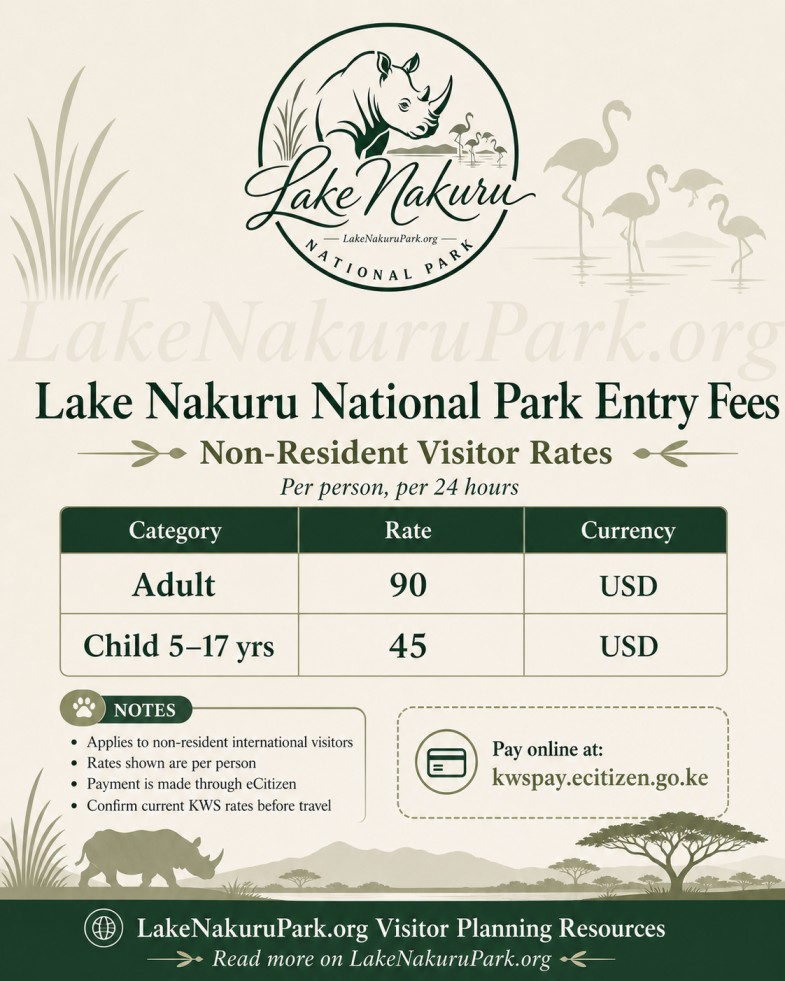
Two non-resident adults should budget USD 180 for personal entry fees before adding vehicle charges. If they enter in a standard 6–12 seat safari vehicle, the KWS vehicle charge is usually Ksh 1,500 in addition to the visitor entry total.
The non-resident adult fee increased from USD 60 in the 2024 schedule to USD 90 in the current schedule, a 50% increase. The non-resident child/student fee increased from USD 35 to USD 45, a 28.6% increase.
Lake Nakuru is relatively expensive for international visitors compared with many other KWS parks because it is a Premium Park. A non-resident adult pays USD 90 at Lake Nakuru, compared with USD 80 at Nairobi National Park and USD 50 at Scenic Parks such as Hell’s Gate, Mt Longonot, Lake Elementaita, Shimba Hills, and Kakamega.
African citizens and East African citizens pay lower KWS park fees than international non-residents to keep Kenya’s parks accessible to local and regional visitors while encouraging domestic and inter-African tourism.
Non-residents pay higher fees because international tourism helps fund wildlife conservation, ranger operations, habitat protection, park infrastructure, and long-term management. The pricing model balances affordable access for citizens and African visitors with stronger conservation financing from international tourism.
Child and Student Fees at Lake Nakuru
Children pay reduced Lake Nakuru National Park entry fees unless they qualify for an exemption. The current child/student rates are Ksh 750 for East African citizens, Ksh 1,050 for Kenya residents, USD 25 for African citizens, and USD 45 for non-residents.
| Child / Student Category | Entry Fee |
|---|---|
| East African Citizen | Ksh 750 |
| Kenya Resident | Ksh 1,050 |
| African Citizen | USD 25 |
| Non-Resident | USD 45 |
KWS defines a child as a person from five years but below 18 years. The same current schedule lists children aged five years and younger among persons exempt from conservation fees, so families with children around age five should confirm the exact interpretation before payment and carry proof of age where possible.
The student fee follows the child/student rate, but a student must meet the KWS definition. KWS defines a student as someone not older than 23 years, from a recognized secondary school, college, or university, visiting for educational purposes under a documented and organized arrangement with that institution.
A student ID alone should not be treated as enough. Schools and colleges should carry institutional letters, student lists, IDs, and booking documentation where relevant.
Family Cost Examples for Lake Nakuru
A family should calculate Lake Nakuru fees by separating adults, children, visitor category, vehicle charge, and optional activities. The simplest formula is:
Adult fees + child fees + vehicle fee + selected activity fees = minimum park-related cost.
For example, a family of 2 East African citizen adults and 2 East African citizen children pays Ksh 4,500 in visitor entry fees. If they enter in a small car, the vehicle fee adds Ksh 600, giving a minimum park-related total of Ksh 5,100 before fuel, meals, guiding, picnic charges, or special activities.
| Family Example | Calculation | Total |
|---|---|---|
| 2 EA citizen adults | 2 × Ksh 1,500 | Ksh 3,000 |
| 2 EA citizen children | 2 × Ksh 750 | Ksh 1,500 |
| Small vehicle | 1 × Ksh 600 | Ksh 600 |
| Minimum park-related total | — | Ksh 5,100 |
School trips should not be budgeted from the student fee alone. Schools must also account for teacher or adult supervisor fees, bus charges, meals, documentation, payment logistics, and any special-use fees.
Exemptions from Lake Nakuru Entry Fees
KWS lists several people as exempt from conservation fees, including Kenyan citizens aged 70 years and above, persons with disabilities, children aged five years and younger, and qualifying registered tour drivers, guides, boat crew, and porters.
| Exempt Category | Fee Position |
|---|---|
| Kenyan citizens aged 70 and above | Exempt from conservation fees |
| Persons with disabilities | Exempt from conservation fees |
| Children aged five years and younger | Exempt from conservation fees |
| Qualifying registered tour drivers, guides, boat crew, and porters | Exempt under KWS conditions |
Visitors claiming exemption should carry documents proving the basis of the exemption. Kenyan seniors should carry ID showing citizenship and age, persons with disabilities should carry disability documentation, children may need proof of age, and guides or drivers should carry professional registration documents.
The guide or driver exemption is conditional. KWS refers to tour drivers, guides, boat crew, and porters who are registered by the Tourism Regulatory Authority and are members of a registered association. The exemption applies to the guide’s or driver’s personal conservation fee; it does not automatically remove the vehicle charge or the entry fees for guests.
If you qualify for exemption, your can get approved for exemption at the gate of entry. Carry the required documentation on the day you’re visiting the Park and show your credentials that qualify you for exemption along with your ID. You must have your ID. For tour operators ensure your TRA license is active and have renewed it as KWS Clerks at the gate are able to check validity of your TRA guide certificate.
Guides should not assume exemption if they are not registered or have expired TRA license/certificates. KWS refers to tour drivers, guides, boat crew, and porters who are registered by the Tourism Regulatory Authority and are members of a registered association, so the exemption is conditional rather than automatic.
Exemptions may still require verification through the KWS application and gate-check process. Visitors should enter accurate details during the application and carry documents proving the exemption when they arrive at the park.
An exempt visitor can still be required to show identification at Lake Nakuru National Park. Exemption removes the conservation fee only when eligibility is proven; it does not remove the need to verify identity, age, citizenship, disability status, or professional registration.
How to Pay Lake Nakuru National Park Entry Fees Online
Lake Nakuru entry is paid through the KWS/eCitizen application process. Visitors select Lake Nakuru National Park, add visitor details, choose the correct visitor category, select the entrance gate, enter the visit date and entry/exit dates, indicate whether they are paying for a vehicle, add camping or special activities if needed, and proceed to payment. KWS’s eCitizen service is designed for users to apply and pay for KWS services through their eCitizen account.
| Application Step | Why It Matters |
|---|---|
| Visit the KWSPay’s payment portal on eCitizen. | https://kwspay.ecitizen.go.ke/single-park-entry/lake-nakuru-national-park/guests |
| Select Lake Nakuru National Park | Starts the correct park application |
| Add visitor details | Identifies who is entering |
| Select visitor category | Determines the fee |
| Select entrance gate | Aligns ticket with route |
| Add date of visit | Ties ticket to travel day |
| Add entry and exit dates | Supports the valid visit period |
| Confirm vehicle payment | Adds or excludes vehicle charge |
| Add special activities | Adds camping or activity fees |
| Complete payment | Confirms application |
Visitors should use the official KWS/eCitizen route rather than unofficial links, screenshots, or old fee tables. The 2024 KWS fee sheet described KWS park payment as cashless through the eCitizen government platform.
Payment options such as M-Pesa or card may appear at checkout depending on the official payment process available at the time. Visitors should complete the application first, confirm the category and charges, then pay using the options shown.
Visitors should avoid relying on payment at the gate. As of May 1, 2026, payment at the gate by M-Pesa or card may still be processed, but it is discouraged because it can create queues and delay entry. The smoother option is to complete the KWS/eCitizen payment online before arriving at Lake Nakuru National Park, especially where network coverage, phone battery, payment confirmation, or visitor-category details could slow the gate process. Paying by cash is not accepted.
A printed ticket is useful, but visitors should also keep a digital copy or screenshot of the payment confirmation on your smartphone. The category selected online should match the ID, passport, resident permit, student document, or exemption proof carried by the visitor. You’ll need to present your ID and the soft copy of your admission ticket.
Paying Lake Nakuru Fees for Someone Else
You can pay Lake Nakuru National Park fees for someone else by completing the KWS/eCitizen payment process on behalf of the visitors, but the visitor details and categories must be correct. The names, visitor categories, dates, entrance gate, vehicle details, and identification documents should match the people entering the park.
This is common when tour operators, schools, companies, families, or group organizers arrange the visit. The person making the payment is less important than the accuracy of the visitor information.
A Kenyan citizen, Kenya resident, African citizen, and non-resident cannot be entered interchangeably because each category has a different fee and may require different documents at the gate. A wrong category can cause delays, corrections, or a requirement to pay the correct fee.
Lake Nakuru Access After Paying for the Ticket:
The gate you choose when purchasing the Park entry ticket online does not change the Lake Nakuru entry fee. The personal fee is determined by visitor category, not by whether you use Lanet Gate, Main Gate, or Nderit Gate.
For route planning, Lanet Gate is usually the best option for visitors coming from Nairobi, Main Gate is usually convenient from Nakuru City, and Nderit Gate may be useful for southern-side routing or accommodation. The online payment flow may ask you to select an entrance gate, so the gate should match your real route, driver plan, hotel location, or itinerary.
| Gate | Best Use Case |
|---|---|
| Lanet Gate | Commonly used from the Nairobi side |
| Main Gate | Convenient from Nakuru City |
| Nderit Gate | Useful for southern-side routing or accommodation |
| Airstrip Gate | Relevant where airstrip access applies |
Park Gates: Open 6:00 AM – Close 6:00 PM daily.
If your route changes after payment, do not assume the gate can be changed automatically. Contact KWS or confirm with the gate team before arrival. For details on the Lake Nakuru NP gate locations, route planning and more, read more on Lake Nakuru Park entry gates.
The gate also does not affect vehicle charges. Vehicle charges are based on seating capacity, not gate selection.
Ticket Validity and Re-Entry
A Lake Nakuru National Park ticket is valid for a period not exceeding 24 hours, but KWS defines the daily fee as a fee for single access to a park, reserve, or sanctuary. Visitors should treat the ticket as a time-limited single-entry conservation fee, not an unlimited pass for repeated entry and exit.
This matters for day planning. Visitors should not assume they can leave the park for lunch, fuel, shopping, or a hotel stop and return on the same ticket. If re-entry is important, confirm with KWS before leaving the park.
A morning-and-afternoon game drive can work within the valid access period if the visitor remains inside the park. If the plan involves exiting between drives, re-entry should be confirmed first. If staying in accommodations inside the Park, you are allowed entry and re-entry but if staying in accommodations outside the Park, you need to confirm re-entry before leaving.
The best meal plan is to carry packed lunch, use permitted picnic areas, or eat before or after the park visit. This avoids losing value from a single-access ticket.
Visitors returning on a different day should expect to pay for the additional visit period unless KWS, the lodge, or the tour operator confirms that the dates have already been covered in the application.
When applying online, the entry date and exit date should match your actual visit plan. For a single-day game drive, such as a morning or afternoon visit, select the same date as both the entry and exit date. For a multi-day visit, select the first day as the entry date and the final day as the exit date. For example, an entry date of May 1 and an exit date of May 3 would normally be treated as a two-night/extended visit period, giving access across the selected dates according to the fees calculated by the KWS system.
The important point is to choose the correct dates before payment. If you plan to do more than one game drive across different days, do not apply as if it is a single-day visit.
Park Gate Rules and Visitor Regulations
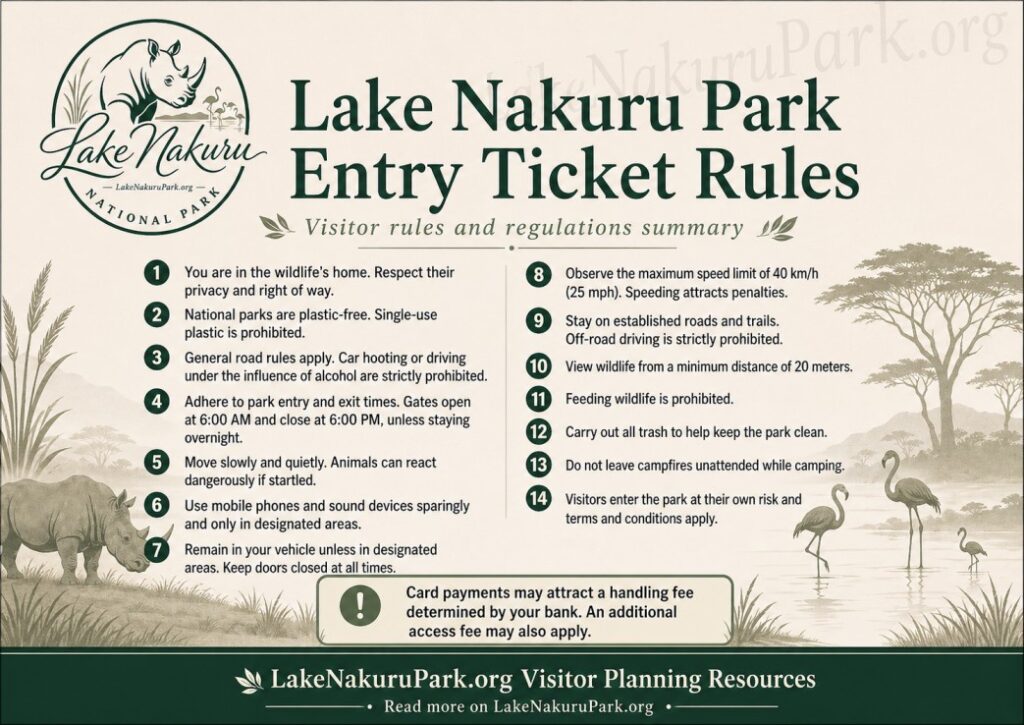
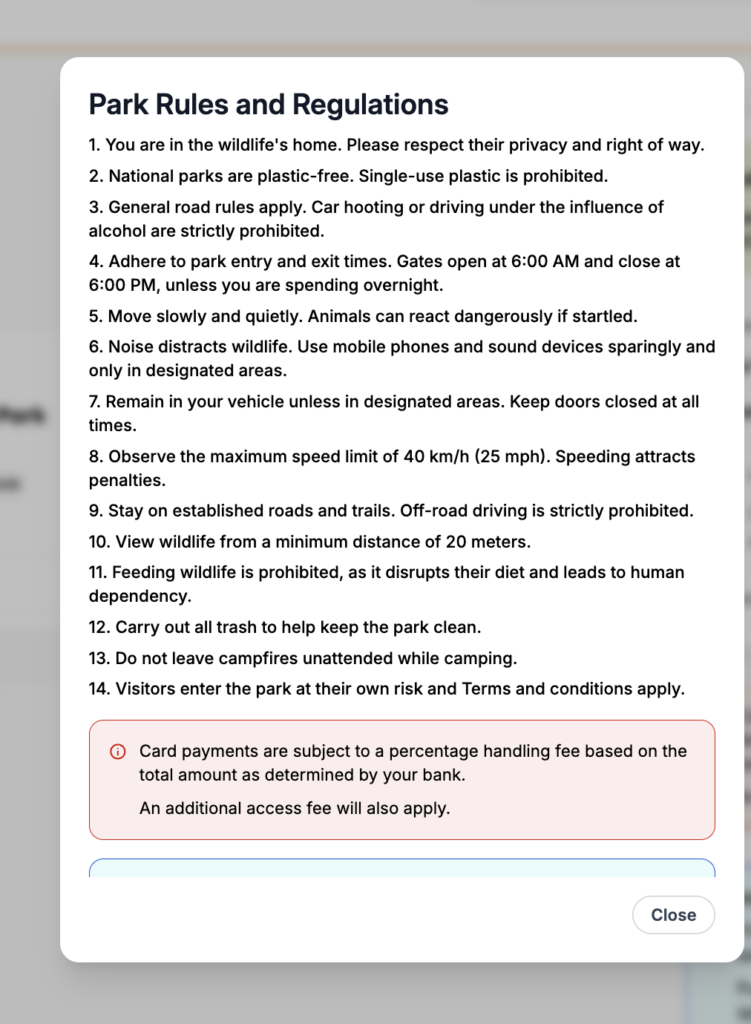
The last step when you’re purchasing the KWS entry ticket for Lake Nakuru NP admission is reading and accepting the conditions for entry which are as follows:
- Respect wildlife at all times. You are entering the animals’ natural habitat, so give wildlife space, privacy, and right of way.
- Keep a safe viewing distance. View animals from at least 20 metres away and never chase, block, surround, feed, touch, or disturb them.
- Remain inside your vehicle. Do not get out of the vehicle except in officially designated areas, and keep vehicle doors closed during game viewing.
- Drive slowly and carefully. The maximum speed limit is 40 km/h / 25 mph. Speeding is dangerous and may attract penalties.
- Stay on designated roads and trails. Off-road driving is strictly prohibited because it damages vegetation, disturbs habitats, and endangers wildlife.
- Keep noise to a minimum. Avoid shouting, loud music, unnecessary hooting, and excessive use of phones or sound devices.
- Do not drive under the influence. General road rules apply inside the park, and driving while intoxicated is strictly prohibited.
- Observe gate opening and closing times. Park gates generally open at 6:00 AM and close at 6:00 PM, unless you are staying overnight in an approved facility.
- Do not feed wildlife. Feeding animals disrupts their natural diet, encourages dependency, and may make them aggressive toward people.
- Avoid single-use plastic. National parks are plastic-free zones, and single-use plastic items are prohibited.
- Carry out all trash. Do not throw litter, food scraps, bottles, wrappers, tissues, or cigarette ends inside the park.
- Use campfires responsibly. If camping, never leave a campfire unattended and ensure it is fully extinguished before leaving or sleeping.
- Carry original identification. Park tickets are nominative, non-transferable, and non-refundable, so visitors should carry original ID for gate verification.
- Use tickets only for the selected park and date. A ticket grants access only to the park chosen during purchase and only for the date or period selected.
- Purchase tickets through approved channels. Visitors may register and pay through the dedicated KWS eCitizen platform or purchase at the gate where available.
- Expect possible payment charges. Card payments may attract a handling fee determined by your bank or payment provider, and additional access fees may apply.
- Enter at your own risk. Wildlife areas contain natural hazards, wild animals, rough roads, and changing conditions, so visitors must follow ranger instructions and park terms at all times.
Lake Nakuru Vehicle Entry Charges
Lake Nakuru National Park vehicle entry fees are charged per vehicle per day according to seating capacity. Vehicle charges are separate from personal entry fees. A small car with fewer than 6 seats pays Ksh 600, while many safari vans and Land Cruisers fall into the 6–12 seat category and pay Ksh 1,500 per day.
| Vehicle Capacity | Vehicle Fee Per Day |
|---|---|
| Less than 6 seats | Ksh 600 |
| 6–12 seats | Ksh 1,500 |
| 13–24 seats | Ksh 3,000 |
| 25–44 seats | Ksh 4,500 |
| 45 seats and above | Ksh 5,000 |
A safari Land Cruiser’s KWS vehicle entry fee should not be confused with the cost of hiring the Land Cruiser. Vehicle hire, driver-guide service, fuel, and tour operator costs are separate.
The question “Are you paying for your vehicle?” on the KWS application asks whether the vehicle charge should be added to your Lake Nakuru entry application. Self-drive visitors usually select Yes. Tour guests should select No only if the operator has already included or paid the KWS vehicle charge. You should confirm if vehicle entry is included in your package when purchasing your ticket. All our Lake Nakuru National Park tour packages include the vehicle and driver entry fees and guests only need to purchase their own specific park tickets.
Driver, vehicle, and visitor fees are separate. The vehicle fee is charged by seating capacity. Visitor fees are charged per person. A driver-guide’s personal conservation fee may be exempt only if the guide qualifies under KWS exemption rules.
Self-Drive Cost Examples at Lake Nakuru
Self-drive cars are allowed into Lake Nakuru National Park if the visitor pays the correct personal entry fees and vehicle charge. Self-drive cost starts with visitor entry fees + vehicle fee, then adds fuel, meals, guiding if used, camping, picnic fees, boating, or special activities.
| Self-Drive Example | Minimum Park-Related Cost |
|---|---|
| 1 EA citizen adult in small car | Ksh 2,100 |
| 2 EA citizen adults in small car | Ksh 3,600 |
| 2 EA citizen adults + 2 children in small car | Ksh 5,100 |
| 2 Kenya resident adults in small car | Ksh 4,650 |
| 2 non-resident adults in small car | USD 180 + Ksh 600 |
These examples include personal entry and the small-vehicle fee only. They do not include fuel, meals, guiding, accommodation, camping, or special activities.
Self-drive from Nakuru or nearby areas is usually the cheapest way to visit. A day trip from Nairobi costs more because distance, fuel, driver time, and vehicle use become major cost factors.
Parking Charges at Lake Nakuru
KWS lists parking charges for Lake Nakuru, but the current fee schedule states that vehicle parking charges are not applicable to park visitors with paid tickets. For ordinary visitors, the more relevant cost is the vehicle entry charge by seating capacity.
| Parking Category | Listed Parking Charge |
|---|---|
| East African citizens / residents | Ksh 1,000 |
| African citizens / non-residents | USD 30 |
| Paid park visitors | Not applicable |
Parking and vehicle entry are not the same thing. The vehicle entry fee is the normal charge for taking a vehicle into the park. The parking fee is a separate listed charge, but KWS states it is not applicable to park visitors with paid tickets.
Parking is not treated as an extra charge for normal paid park visitors under the wording of the current KWS schedule. Since you won’t have to pay separate parking fee, you can technically say it is ‘included’ in your park entry fees.
For a normal game drive, calculate the visit as:
Visitor entry fees + vehicle entry charge + optional activity fees.
Camping Fees at Lake Nakuru
Camping fees are not included in Lake Nakuru National Park entry fees. Campers must pay the normal conservation entry fee first, then add the relevant public or special campsite fee, plus vehicle and other costs where applicable.
Public Camping Fees
To camp at Lake Nakuru NP’s public campsites such as Makalia Falls Campsite, non-residents pay USD 30 per adult / USD 25 per child, or USD 50 per adult / USD 25 per child for special camping. These camping fees are separate from the normal non-resident entry fee of USD 90 per adult / USD 45 per child.
Below are all applicable public camping rates for different categories:
| Public Campsite Category | Adult | Child |
|---|---|---|
| East African Citizen | Ksh 250 | Ksh 200 |
| Kenya Resident | Ksh 350 | Ksh 250 |
| African Citizen | USD 15 | USD 13 |
| Non-Resident | USD 30 | USD 25 |
Special Camping Fees
| Special Campsite Category | Adult | Child |
|---|---|---|
| East African Citizen | Ksh 500 | Ksh 250 |
| Kenya Resident | Ksh 700 | Ksh 350 |
| African Citizen | USD 25 | USD 15 |
| Non-Resident | USD 50 | USD 25 |
Public campsites are the lower-cost camping option. Special campsites cost more and may require more advance coordination. KWS also lists a Ksh 10,000 non-refundable reservation fee per week for special campsites.
Campers still pay entry fees. Camping charges do not replace conservation fees; they are added on top of visitor entry, vehicle charges, food, equipment, and any reservation requirements.
Camping is added through the Lake Nakuru online application by selecting the relevant special activity before payment. The final payable amount should include both the normal entry fee and the selected camping fee. See snapshot below:
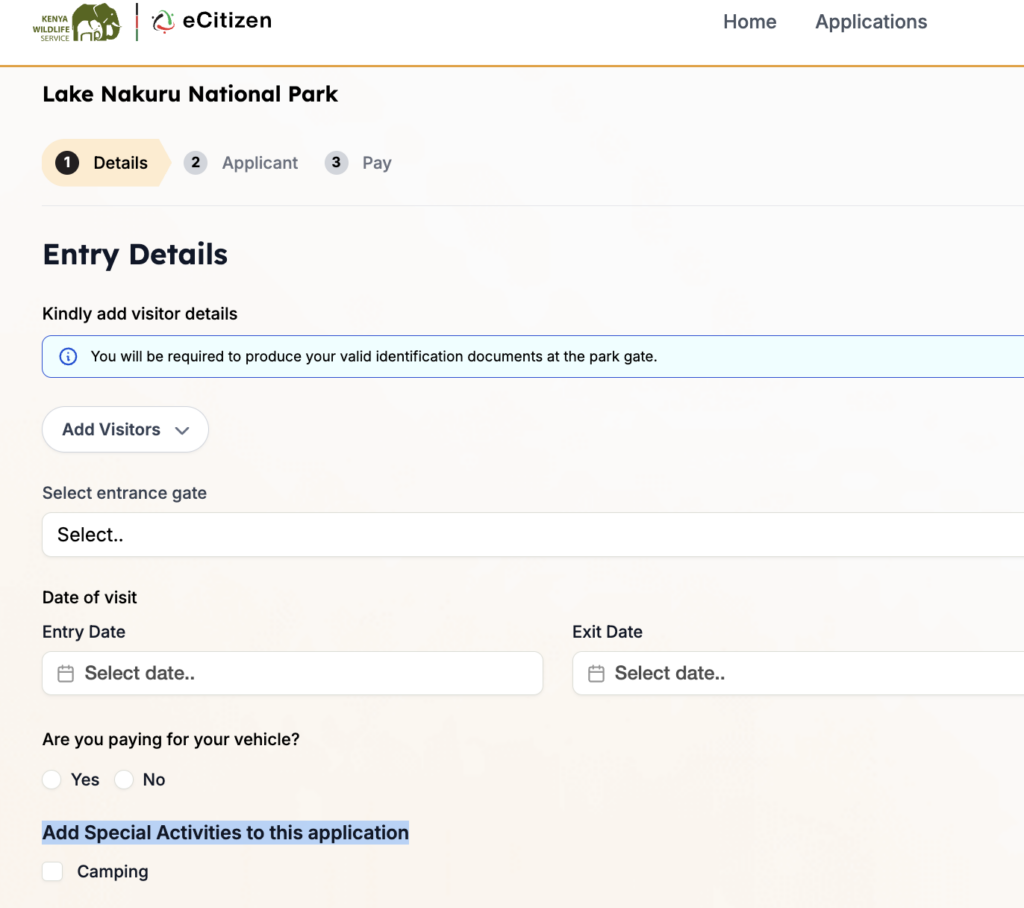
Kenyan citizens fall under the East African Citizen category for camping. They pay Ksh 250 per adult / Ksh 200 per child for public camping, or Ksh 500 per adult / Ksh 250 per child for special camping, in addition to normal entry fees.
Camping can be cheaper than many lodge or hotel stays, but it is not automatically the cheapest total option. Campers still need to budget for entry fees, vehicle charges, camping fees, food, gear, water, transport, and possibly special campsite reservation fees.
Special Activity Fees at Lake Nakuru
Special activities are not included in the normal Lake Nakuru entry fee. KWS lists tourism experience fees separately and states that tourism experience fees do not include entry fees.
| Special Activity | East African Citizens / Residents | African Citizens / Non-Residents |
|---|---|---|
| Animal tracking | Ksh 2,000 | USD 20 |
| Lake boating | Ksh 1,500 | USD 15 |
| Night game drive | Ksh 3,000 | USD 50 |
| Helicopter tourism | Ksh 5,000 | USD 100 |
| Wildlife conservation and management experiences | Ksh 20,000 | USD 200 |
Animal tracking is listed at Ksh 2,000 per person for East African citizens and residents, and USD 20 per person for African citizens and non-residents. It is exclusive of normal park entry and should be arranged in advance where required.
Lake boating is listed at Ksh 1,500 per person per hour for East African citizens and residents, and USD 15 per person per hour for African citizens and non-residents. This is an activity fee only, not a replacement for park entry.
Night game drives are listed at Ksh 3,000 per person per trip for East African citizens and residents, and USD 50 per person per trip for African citizens and non-residents. Night drives should be confirmed before planning around them because availability may depend on park rules, timing, security, and operational approval.
Security guided tours are charged per group, per ranger, with a minimum of two rangers. KWS lists Ksh 2,000 per ranger for up to 4 hours and Ksh 4,000 per ranger for more than 4 hours.
Helicopter tourism is listed at Ksh 5,000 per person for East African citizens and Kenya residents, and USD 100 per person for African citizens and non-residents, for up to two hours per park or reserve. This is a specialist activity that should be confirmed with KWS before payment.
Participation in wildlife conservation and management experiences is listed at Ksh 20,000 per person per day for East African citizens and Kenya residents, and USD 200 per person per day for African citizens and non-residents. This is a specialist conservation activity, not a normal game-drive fee.
Special activity fees do not include Lake Nakuru National Park entry fees. KWS states that tourism experience fees do not include entry fees, so visitors still need to pay the normal conservation fee for their visitor category.
For Lake Nakuru special activities, visitors should contact KWS through 0800 597 000 or customerservice@kws.go.ke. The KWS fee schedule also lists +254 726 610 509 for customer enquiries. Special activities should be confirmed before payment because some require prior arrangement or approval.
Drone, Filming, and Photography Fees
Drone use at Lake Nakuru should be treated as a regulated activity, not as ordinary tourist photography. KWS lists drone charges separately from normal conservation fees and states that KCAA licences are required. Note that KCAA had initially launched an online platform to apply for drone pilot licensed but has since suspended as per this KCAA notice.
The KWS 2025 fee schedule lists drone charges at Ksh 5,000 per drone per day for East African citizens and USD 300 per drone per day for non-residents, with KCAA licences required. The online application extract provided showed USD 500 for African citizens and non-residents, so drone users should confirm the current payable amount directly with KWS before applying.
Paying a drone charge is not the same as having permission to fly. Drone use requires the correct aviation approval and park-level authorization before the equipment is used inside the park.
Filming and professional photography at Lake Nakuru are charged separately from normal entry fees. The KWS schedule lists weekly filming or photography fees by crew size: Ksh 16,000 / USD 200 for 1–5 crew members, Ksh 24,000 / USD 350 for 6–10 crew members, and Ksh 40,000 / USD 500 for 11 or more crew members.
Below is a summary table for all filming and photography charges at Lake Nakuru NP:
| Crew Size | EA Citizen / Resident | African Citizen / Non-Resident |
|---|---|---|
| 1–5 crew members | Ksh 16,000 | USD 200 |
| 6–10 crew members | Ksh 24,000 | USD 350 |
| 11+ crew members | Ksh 40,000 | USD 500 |
Photography for weddings, graduations, and personal events is listed at Ksh 20,000 per group for East African citizens and residents, and USD 300 per group for African citizens and non-residents. These charges are separate from normal conservation entry fees.
Ordinary tourists can take personal travel photos during a normal Lake Nakuru visit without paying filming fees. Personal phone or camera photos are different from organized filming, professional photography, formal event photography, drone use, or commercial shoots.
Professional photo sessions are not included in the Lake Nakuru entry fee. A normal park ticket covers ordinary visitor access, while formal shoots, wedding shoots, graduation shoots, commercial photography, filming, and drone use are treated as special activities with separate fees.
Ordinary tourists can take personal phone or camera photos during a normal Lake Nakuru visit without paying filming fees. Extra charges apply when photography becomes a regulated activity, such as commercial filming, professional shoots, drone use, weddings, graduations, event photography, or other organized production use.
Conferencing, Corporate Events, and Event Fees
Lake Nakuru National Park has conferencing and event-related fees listed separately from ordinary park entry fees. Conferencing should be treated as a special-use activity, not as normal visitor admission.
The Lake Nakuru application extract lists conferencing fees by visitor category:
| Conferencing Category | Adult | Child |
|---|---|---|
| East African Citizen | Ksh 1,050 | Ksh 525 |
| Kenya Resident | Ksh 1,620 | Ksh 735 |
| African Citizen | USD 35 | USD 20 |
| Non-Resident | USD 63 | USD 36 |
The conference hall is charged separately. The Lake Nakuru application extract lists Conference Hall: Ksh 3,000, and Kitchen Hire: Ksh 2,000. These are facility-use charges, not normal park entry fees.
KWS lists event-site fees for Premium and Urban Parks, and Lake Nakuru is a Premium Park. These event-site charges are exclusive of conservation fees and security charges.
| Event Size | Event-Site Fee |
|---|---|
| 10–30 pax | Ksh 20,000 / USD 200 |
| 31–50 pax | Ksh 30,000 / USD 300 |
| 51–100 pax | Ksh 80,000 / USD 800 |
Event security is listed at Ksh 87,000 per section of 10 rangers per day for East African citizens and residents, and USD 1,000 for African citizens and non-residents. KWS also notes that security fees for one section of rangers apply for event sites after 6:30 pm.
Kitchen hire is listed at Ksh 2,000 in the Lake Nakuru application extract. This is a facility-use charge and should be added separately where kitchen use is part of a conference, company event, school event, picnic, or private function.
Companies can hold events inside Lake Nakuru National Park under KWS terms and conditions, but this should be arranged directly with KWS. The budget should not stop at the event-site fee. Companies should ask for a full quote covering conservation fees, venue or site use, security, vehicle charges, conferencing, kitchen hire, photography or filming, and any after-hours requirements.
Event organizers should contact KWS before planning a corporate event, conference, photo session, or special function at Lake Nakuru. The KWS fee schedule lists 0800 597 000, customerservice@kws.go.ke, and +254 726 610 509 for customer enquiries.
Group, School, and MICE Fees
KWS lists group rates for Meetings, Incentives, Conferences and Events with prior bookings. The rates are calculated as a percentage of the applicable park entry fees.
| Group Size | Listed Group Rate |
|---|---|
| 10–29 participants | 5% of applicable park entry fees |
| 30–49 participants | 10% of applicable park entry fees |
| 50–99 participants | 20% of applicable park entry fees |
| 100+ participants | 30% of applicable park entry fees |
These group rates should not be assumed for every large family, school, church, or casual visitor group. The wording is tied to MICE and prior bookings, so organized groups should confirm eligibility with KWS before payment.
School groups pay based on the number of students, teachers, adults, vehicle size, and whether students qualify for the KWS student rate. Student rates follow the child/student column, but the visit must meet the documented educational-visit conditions.
A Lake Nakuru school trip should carry institutional documentation, student lists, teacher or supervisor details, student IDs where available, and KWS booking or payment confirmation. Teachers and adult supervisors should be budgeted at adult rates unless KWS confirms a specific exemption.
Buses are charged by seating capacity. A 13–24 seat vehicle pays Ksh 3,000, a 25–44 seat vehicle pays Ksh 4,500, and a 45-seat-and-above vehicle pays Ksh 5,000 per day.
Read more on MICE, School and Group Bookings:
- School groups should budget Lake Nakuru as a multi-part cost: student entry fees, teacher/adult fees, bus charges, meals, documentation, and any special-use fees. Students may qualify for the child/student rate only if they are 23 or younger, from a recognized school, college, or university, and visiting under a documented educational arrangement.
- A student ID alone may not be enough. Schools should carry an institutional letter, student list, supervisor details, student IDs where available, and KWS booking or payment confirmation. Teachers and adult supervisors are normally charged adult rates unless KWS confirms an exemption.
- Bus charges are separate from entry fees and depend on seating capacity: Ksh 3,000 for 13–24 seats, Ksh 4,500 for 25–44 seats, and Ksh 5,000 for 45 seats and above.
- MICE or organized group rates are not automatic walk-in discounts. They require prior booking and may still involve extra costs such as event-site fees, conferencing, security, vehicle entry, kitchen hire, photography, filming, or other special activities.
Safari Packages and Park Fees
Lake Nakuru entry fees are not automatically included in safari packages. Some tour operators include KWS park fees in the quote, while others quote only transport, vehicle, driver-guide, and fuel, then ask guests to pay park entry separately.
| Package Item | Commonly Included? |
|---|---|
| Safari vehicle | Usually |
| Driver-guide | Usually |
| Fuel | Usually |
| Transfers | Often |
| Vehicle entry fee | Sometimes |
| Visitor park entry fees | Often excluded |
| Meals | Sometimes |
| Accommodation | Only in overnight packages |
| Special activities | Usually separate |
Some tours exclude park fees because KWS fees vary by visitor category. A Kenyan citizen, Kenya resident, African citizen, and non-resident do not pay the same amount, so operators sometimes quote transport and guiding separately and let visitors pay their own category-specific park fees.
A private Lake Nakuru safari with park fees should be calculated as:
Tour service cost + KWS visitor entry fees + vehicle entry charge + meals or accommodation where applicable.
| KWS Cost Item | Current Rate |
|---|---|
| East African citizen adult entry | Ksh 1,500 |
| Kenya resident adult entry | Ksh 2,025 |
| African citizen adult entry | USD 50 |
| Non-resident adult entry | USD 90 |
| Safari vehicle, usually 6–12 seats | Ksh 1,500 per day |
A Lake Nakuru day tour from Nairobi should be priced as transport and guiding cost plus KWS park fees. The park fee does not change because the visitor starts in Nairobi, but the total cost rises because of fuel, driver-guide time, road distance, vehicle hire, and full-day logistics.
A private tour from Nakuru is usually cheaper than a day tour from Nairobi because the transfer distance is shorter.
A guided Lake Nakuru safari can be worth the extra cost if the guide improves routing, wildlife interpretation, rhino-viewing chances, bird identification, viewpoint timing, and time management. The entry fee gives access, but it does not provide expertise.
Visitors can pay Lake Nakuru fees themselves for direct control over the ticket, or let a tour operator pay if the operator is reliable and uses the correct visitor categories. Whether the visitor or operator pays, the category must match the ID, passport, or resident permit shown at the gate.
Before booking a Lake Nakuru safari package, visitors should confirm whether the quote includes KWS visitor entry fees, vehicle entry fees, driver-guide, fuel, meals, accommodation, pick-up and drop-off, and special activities. The best quote is not always the cheapest one; it is the one that clearly separates government park fees from tour service costs.
Lake Nakuru Day Trip and Budget Planning
A Lake Nakuru day trip costs more than the entry ticket alone. At minimum, visitors should budget for park entry fees plus vehicle charges. A fuller budget may also include fuel, driver-guide, meals, transfers, accommodation, and optional activities.
| Day-Trip Scenario | Minimum Park-Related Cost |
|---|---|
| 1 EA citizen adult in small car | Ksh 2,100 |
| 2 EA citizen adults in small car | Ksh 3,600 |
| 2 EA citizen adults + 2 children in small car | Ksh 5,100 |
| 2 Kenya resident adults in small car | Ksh 4,650 |
| 2 non-resident adults in small car | USD 180 + Ksh 600 |
The cheapest way to visit Lake Nakuru is usually self-drive from Nakuru or nearby towns in a small vehicle, using the correct visitor category and avoiding unnecessary add-ons.
One person should budget according to visitor category, vehicle arrangement, and starting point. One East African citizen adult self-driving in a small car should budget at least Ksh 2,100. One non-resident adult in a small car should budget USD 90 + Ksh 600.
A couple entering together in a small vehicle should budget two adult entry fees plus one vehicle fee. Two East African citizen adults in a small car pay Ksh 3,600 before fuel and other costs.
Lake Nakuru can be cheaper per person with a group because vehicle and transport costs are shared. The entry fee remains per person, but the vehicle charge is paid per vehicle, not per visitor.
Why Lake Nakuru Justifies a Premium KWS Pricing Tier
- Rhino sanctuary value: Lake Nakuru protects both black and white rhinos, making it one of Kenya’s most reliable rhino-viewing parks.
- High conservation cost: Rhino security requires intensive ranger patrols, monitoring, fencing, habitat management, and anti-poaching investment.
- World-class birding: The park supports exceptional bird diversity, including flamingos, pelicans, fish eagles, herons, raptors, and migratory birds.
- Flamingo heritage: Lake Nakuru’s global reputation was built on its historic flamingo spectacle, even though numbers now vary with lake conditions.
- UNESCO-linked landscape: Lake Nakuru forms part of the Kenya Lake System in the Great Rift Valley, giving it international conservation significance.
- Compact wildlife density: Visitors can see rhinos, buffalo, giraffes, zebras, baboons, antelopes, birds, and possible predators within a relatively small area.
- Scenic Rift Valley setting: The park combines a lake basin, cliffs, hills, acacia woodland, grassland, waterfalls, and panoramic viewpoints.
- Premium visitor experience: Baboon Cliff, Lion Hill, Out of Africa Hill, Makalia Falls, lake-shore drives, and rhino areas create a varied safari route.
- High ecological sensitivity: Lake levels, water chemistry, flamingo movement, shoreline habitats, and catchment pressure require active management.
- Strong accessibility: The park is easy to reach from Nairobi, Nakuru, Naivasha, Elementaita, and the Maasai Mara route, giving visitors high safari value with less travel time.
- Multi-asset safari value: Lake Nakuru combines rhinos, birds, scenery, lake ecology, predators, viewpoints, and conservation importance in one park.
- Conservation funding logic: A higher fee tier helps support wildlife protection, road maintenance, waste management, visitor infrastructure, and long-term park management.
Local Visitor Planning
Local visitors who qualify as East African citizens pay Ksh 1,500 per adult and Ksh 750 per child or eligible student. A small car with fewer than 6 seats adds Ksh 600, so one Kenyan adult in a small car should budget at least Ksh 2,100 before fuel, food, guide fees, or activities.
Nakuru residents do not have a separate local-town or county resident rate in the KWS fee schedule. A Nakuru resident pays according to their official visitor category: East African Citizen, Kenya Resident, African Citizen, or Non-Resident.
Lake Nakuru fees are not listed differently for weekends or public holidays in the current KWS schedule. The wider trip cost can still rise during busy periods because accommodation, tour prices, traffic, guide availability, and gate congestion may change.
Lake Nakuru can work well for a local picnic if visitors treat it as a national park visit first, not just a picnic ground. The normal conservation entry fee applies, vehicle charges may apply, and KWS lists picnic charges within KWS stations separately at Ksh 100 for East African citizens/residents and USD 10 for African citizens/non-residents.
Lake Nakuru can be worth it for local visitors when the visit is planned as a full park experience rather than a short stop. A Kenyan citizen adult now pays Ksh 1,500, up from Ksh 860 in 2024, so the visit should be planned to make the ticket count.
Lake Nakuru Fees Compared with Other Parks
Lake Nakuru is more expensive than many KWS parks because it is classified as a Premium Park. It has the same KWS entry fee as Amboseli but higher rates than Nairobi National Park, Tsavo East, Tsavo West, Meru, Aberdare, Hell’s Gate, Mt Longonot, Lake Elementaita, Shimba Hills, and Kakamega.
| Park Category | Example Parks | EA Citizen Adult | Non-Resident Adult |
|---|---|---|---|
| Premium Parks | Lake Nakuru, Amboseli | Ksh 1,500 | USD 90 |
| Urban Park | Nairobi National Park | Ksh 1,000 | USD 80 |
| Wilderness Parks A | Tsavo East, Tsavo West | Ksh 1,000 | USD 80 |
| Wilderness Parks B | Meru, Kora, Aberdare | Ksh 800 | USD 70 |
| Scenic Parks | Hell’s Gate, Mt Longonot, Lake Elementaita, Shimba Hills, Kakamega | Ksh 500 | USD 50 |
Lake Nakuru is more expensive than Hell’s Gate. East African citizen adults pay Ksh 1,500 at Lake Nakuru and Ksh 500 at Hell’s Gate. Non-resident adults pay USD 90 at Lake Nakuru and USD 50 at Hell’s Gate.
Lake Nakuru is also more expensive than Lake Elementaita Wildlife Sanctuary and Nairobi National Park. Nairobi National Park is cheaper and more convenient from Nairobi; Lake Nakuru offers a Rift Valley lake setting and a different safari landscape.
Lake Nakuru and Amboseli have the same KWS entry fees because both are Premium Parks. The fee is the same, but the safari experience is different: Amboseli is associated with elephants and Kilimanjaro views, while Lake Nakuru is associated with rhinos, lake scenery, birdlife, woodland, and viewpoints.
Lake Nakuru fees should not be used to estimate Masai Mara fees. Lake Nakuru is priced under the KWS conservation fee schedule, while Masai Mara fees are managed separately by reserve or conservancy authorities.
Is Lake Nakuru Worth the Entry Fee?
Lake Nakuru National Park is worth the entry fee when visitors use it as a full safari destination, not a short roadside stop. The fee gives stronger value when the visit includes a proper game drive, rhino-focused wildlife viewing, lake scenery, viewpoints, birding, photography, and enough time inside the park.
Lake Nakuru is expensive because KWS classifies it as a Premium Park and because the current fees increased sharply from the 2024 rates. The East African citizen adult fee rose from Ksh 860 to Ksh 1,500, and the non-resident adult fee rose from USD 60 to USD 90.
Lake Nakuru is worth visiting for rhinos if rhino viewing is one of the visitor’s main priorities. It can also be worth visiting for flamingos and birdlife, but visitors should not judge the whole ticket only by flamingo expectations because flamingo numbers vary with water levels, food availability, and seasonal movement.
Lake Nakuru is better value than Hell’s Gate only when the visitor wants a classic wildlife game drive. Hell’s Gate is cheaper and better for budget scenic outings, cycling, cliffs, and walking-style exploration. Lake Nakuru is better for rhinos, lake scenery, birding, viewpoints, and a more traditional national park safari.
Visitors get the best value from a Lake Nakuru ticket by entering early, using the correct gate, planning the game-drive route, carrying meals or planning picnic time carefully, avoiding unnecessary exits, and spending enough time inside the park.
Refunds, Date Changes, Payment Problems, and Gate Issues
Lake Nakuru fees should be treated as non-refundable after payment. Some KWS charges, such as special campsite reservation fees, are clearly listed as non-refundable, and the ticket issued after payment may state that it is non-refundable, non-transferable, and not date-adjustable.
In practice, KWS may still help with genuine corrections, such as fixing an error or adjusting a visit date, especially if you contact them early. However, these changes are discretionary and should not be assumed.
In our past experience dealing with KWS, refunds are much harder than corrections. Visitors should therefore check the visitor category, visit date, entrance gate, vehicle details, and any special activities carefully before submitting the application.
If a visitor pays under the wrong fee category, the ticket may not match the identification documents checked at the gate. This can cause delays, correction requirements, or a need to pay the correct category fee.
If a visitor misses the selected visit date, they should not assume the ticket remains valid for another day. The KWS daily fee is defined as single access valid for a period not exceeding 24 hours.
Visitors should carry valid identification documents at the gate. Kenyan and East African citizens should carry ID or passport. Kenya residents should carry resident documentation. African citizens and non-residents should carry passports. Students and exempt visitors should carry supporting documentation.
Children may need identification or proof of age at Lake Nakuru gate, especially where a child rate or exemption is being claimed. Families should carry a birth certificate, passport, school document, or other proof of age where possible, especially for children near the age threshold.
Visitors should not plan to enter Lake Nakuru without completing the KWS/eCitizen payment process. If they arrive without an online ticket, they may still need to complete the digital application before entry, which can delay the game drive if there is poor network, low phone battery, or category confusion.
If the KWS payment portal fails, visitors should first check whether payment was deducted before trying again. They should save transaction messages, payment references, screenshots, and application confirmations.
For Lake Nakuru fee problems, visitors can contact KWS through 0800 597 000, customerservice@kws.go.ke, or +254 726 610 509, which are listed for customer enquiries in the KWS fee schedule.
Booking Lake Nakuru Entry Online
Lake Nakuru entry is booked through the KWS/eCitizen application process. Visitors select Lake Nakuru National Park, add visitor details, choose the correct visitor category, select the entrance gate, enter the visit dates, indicate whether they are paying for a vehicle, add camping or special activities if needed, review the charges, and proceed to payment.
Visitors should book before arrival where possible. This reduces gate delays caused by poor network, low phone battery, missing documents, category confusion, or uncertainty over whether a tour operator has already paid.
A tour operator can include Lake Nakuru tickets in a safari package, but this must be clearly stated in the quote. Some operators include KWS entry fees; others exclude them and ask guests to pay directly. Visitors should always confirm whether park tickets are included or paid separately.
Visitors should book tickets themselves if they want direct control over visitor categories, payment confirmation, and ticket records. They can let a guide or operator handle payment if the operator is reliable, transparent, and uses the correct category for each visitor.
Special activities may appear in the online application flow, but availability should be confirmed directly with KWS before relying on them. Activities such as animal tracking, boating, night game drives, drone use, filming, conferencing, events, and security-guided tours may require prior arrangement or approval.
Below is the eCitizen payment link to use: https://kwspay.ecitizen.go.ke/single-park-entry/lake-nakuru-national-park/pay
Final Pre-Payment Checklist
Before paying Lake Nakuru National Park fees, confirm the fee category, visit date, entrance gate, vehicle responsibility, vehicle size, and any special activities. Most pricing problems begin before payment, not at the gate.
| Check Before Payment | Why It Matters |
|---|---|
| Visitor category | Determines the fee |
| Adult, child, student, or exempt status | Changes the amount payable |
| ID or passport | Proves eligibility |
| Resident permit | Needed for resident rate |
| Student documents | Needed for student rate |
| Child age proof | Supports child fee or exemption |
| Visit date | Ticket should match travel day |
| Entry and exit dates | Supports the valid visit period |
| Entrance gate | Should match the route |
| Vehicle payment responsibility | Avoids unpaid or duplicated charges |
| Vehicle seating capacity | Determines vehicle fee |
| Camping or special activities | Adds separate costs |
| Tour package inclusions and exclusions | Prevents surprise payments |
| Payment confirmation | Needed for gate verification |
| KWS contact details | Useful for corrections and special cases |
Families should confirm adult and child counts, age proof, vehicle charges, meals, and picnic or activity costs. Schools should confirm student eligibility, teacher fees, bus charges, documentation, and prior booking. Companies should confirm event-site fees, conservation fees, security, conferencing, vehicle charges, kitchen hire, filming, and after-hours requirements. Tour groups should confirm whether KWS fees are included or paid separately.
For an accurate Lake Nakuru budget, start with the visitor entry fee, add the vehicle charge, then add only the transport, food, accommodation, camping, event, or activity costs that apply to your visit.
What the New Lake Nakuru Fees Mean for Visitors and Conservation
The October 2025 KWS fee revision represents one of the most significant park-fee adjustments in nearly two decades. For Lake Nakuru National Park, the new 2026 rates raise entry costs across all visitor categories, with the sharpest percentage increases affecting East African citizens, children, and residents.
| Visitor Category | Old Rate | New Rate | Increase |
|---|---|---|---|
| EA Citizen Adult | KES 860 | KES 1,500 | 74% |
| EA Citizen Child | KES 215 | KES 750 | 249% |
| Kenya Resident Adult | KES 1,200 | KES 2,025 | 69% |
| Non-Resident Adult | USD 60 | USD 90 | 50% |
| Non-Resident Child | USD 35 | USD 45 | 29% |
The revision reflects KWS’s shift toward a more financially sustainable conservation model. Park fees had remained relatively low for many years despite inflation, currency depreciation, rising operational costs, and growing pressure on protected areas. Lake Nakuru, as a premium park with a major rhino sanctuary, important bird habitats, road networks, ranger operations, and high visitor use, requires consistent funding for management and protection.
For East African citizens and residents, the increase is substantial, especially for families. Even so, domestic visitors still pay far less than international tourists, maintaining a subsidized access structure. For non-residents, the new USD 90 adult rate places Lake Nakuru closer to other high-value African safari destinations while reflecting its rhino viewing, birdlife, Rift Valley scenery, and conservation importance.
The main justification for the higher fees is improved conservation financing. Additional revenue is expected to support ranger patrols, anti-poaching work, road maintenance, signage, waste management, campsite upkeep, digital payment systems, and general park operations.
The short-term effect may be higher trip costs, particularly for domestic families and budget travelers. The long-term benefit, if revenue is well managed, should be stronger wildlife protection, better visitor infrastructure, and more stable funding for Lake Nakuru National Park’s conservation role.
The new pricing therefore raises the standard for both sides. Visitors should budget more carefully and understand that Lake Nakuru is now priced as a premium conservation destination. KWS, in turn, must make the value visible through better infrastructure, stronger protection, clearer communication, and consistent reinvestment in the park.
The fee increase is ultimately a test of conservation financing. If managed transparently and reinvested well, the higher rates can support a stronger future for Lake Nakuru National Park: better protected rhinos, healthier habitats, improved visitor facilities, and more stable funding for one of Kenya’s most distinctive Rift Valley parks.
If interested in visiting Lake Nakuru NP, consider picking our tours choosing from day trip option to combined 3 days+ options on our Lake Nakuru National Park Safaris page.